Get peace of mind with third party cover
Save up to £518* on your car insurance
Compare deals from over 100 providers
Enter registration no. (optional):
Third party insurance is the most basic kind of car insurance that you can get. It covers you in the event of any damage caused to a third party or their property; a car that you crash into, for example.
Third party insurance will not cover you against damage to your own vehicle though, so you may want to opt for a higher level of cover, depending on what you think you'll need.
If you take out a third party insurance policy, you'll be covered against any damage you cause to anyone else or their property, including your passengers.
So if you crash into someone else's car, or drive into someone's garden wall, the costs of repairs will be paid out by your insurer.
The same goes for any injuries caused to your passengers, or any accidents caused by your passengers.
What will be missing from a basic third party car insurance policy, though, will be cover against any damage to or theft of your own vehicle.
If you think that basic third party cover isn't quite enough cover for you, then you might want to opt for the next level up – third party, fire and theft (TPFT) insurance. This will give you all of the basic third party cover, as well as cover for your own vehicle against fire damage and theft, including any damage caused in the event of a theft (or attempted theft).
If you want more than this still, you can go for fully comprehensive cover, which is the highest level of cover available – though the actual specifics of each fully comprehensive policy will vary slightly from provider to provider.
As a general rule, given that basic third party insurance offers the minimum cover possible, such policies tend to be the cheapest car insurance on the market.
However, this doesn't necessarily mean that you are getting good value; you may find that if you go for a policy offering more cover, you actually get more for your money.
This is because statistically speaking, drivers with only third party cover actually tend to be involved in more accidents, or at least make more claims, than those with, say, a fully comprehensive policy. This leads insurers to bump up the premiums to account for the increased number of payouts being made.
When determining your car insurance premiums, insurers assess several factors to calculate the cost:
Younger drivers, particularly those under 25, typically face higher premiums due to their higher risk of car accidents.
The traffic density and crime rates in your area can impact your insurance costs. High-risk areas with frequent theft or accidents can increase premiums.
The make, model, and any modifications to your vehicle influence the cost. Cars that are more expensive to repair or more prone to theft may result in higher premiums.
If your job requires extensive driving, your insurance may be more expensive. Frequent road use can increase the likelihood of car accidents, affecting your premiums.
Whether you use your car for social purposes, commuting, or both will influence the cost. Higher usage can lead to increased risk and higher premiums.
The total miles you drive annually is a key factor. More miles generally mean a higher risk of accidents and therefore higher insurance costs.
Insurers will consider any previous car insurance claims, penalty points on your driving licence, and past incidents of accidental or malicious damage. A history of claims or infractions can lead to higher premiums.
One of the best ways to keep your premiums low is to build up a good no claims discount by driving carefully and safely over time. This can take a while though, of course, the longer the better, but the discounts you get are often very large.
We found that customers applying for third-party only cover tended to have accrued less of a no claims bonus than customers applying for more comprehensive cover. This correlated with higher premium costs on average:
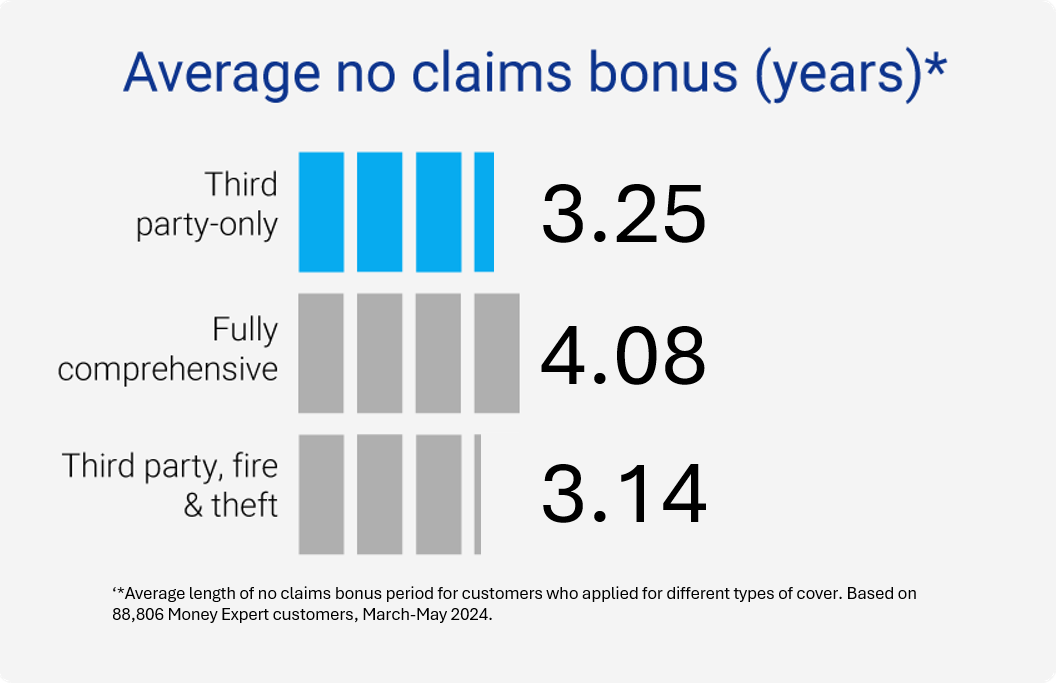
Third party-only: 3.25 years NCB average
Fully comprehensive: 4.08 years NCB average
Third-party, fire and theft: 3.14 years NCB average
Whether or not you have a no claims discount built up, if you want to make sure you get the cheapest third party cover available, you'll need to shop around online. By using our third party car insurance comparison service, you can do just this with little effort and lots of rewards. Just let us know what kind of policy you're after, and we'll bring you up a list of the best car insurance quotes on the market that meet your requirements.
Other factors that can influence the cost of your third party car insurance are:

Each year without making a claim adds to your no-claims discount (NCD). Accumulating more years of NCD can significantly lower the cost of your car insurance.
Keeping your car in a driveway or garage rather than on the street reduces the risk of theft or damage, which can help lower your premiums.
Adding security features like a Thatcham-approved alarm, immobiliser, or steering wheel lock can reduce your insurance costs by making your car less of a target for theft.
For young or inexperienced drivers, completing an advanced driving course can often lead to insurance discounts due to improved driving skills.
Assess whether a third-party policy is sufficient for your needs. Comprehensive insurance may offer better protection and sometimes at a lower cost.
Always compare quotes when shopping for a car insurance policy online. This ensures you find the best coverage at the most competitive price.
You can often enhance your third-party insurance policy with additional coverage options. Here are some common add-ons:
Courtesy Car Cover: This option ensures you have a rental car while yours is being repaired after an accident, minimising disruption to your daily routine.
Breakdown Cover: This add-on helps you if your car breaks down, offering roadside assistance. However, it's worth comparing this with standalone breakdown policies to find the best deal.
Motor Legal Protection: This coverage can assist with legal fees if you're involved in a road accident and someone makes a claim against you, helping to manage potential legal costs.
Key Cover: If your car key is lost or damaged, this add-on covers the expense of replacing it, saving you from unexpected costs.
NCD Protection: Protect your no-claims discount (NCD) with this add-on, which preserves your discount even if you make a claim deemed your fault.
Personal Accident Cover: Since standard third-party insurance does not include medical expenses for injuries you sustain in an accident, personal accident cover provides financial support in the event of serious injury or death.
Yes and no! Third party car insurance is the minimum acceptable level of car insurance in the UK. So, it is mandatory to get at least third party car insurance. You can, however, take out a higher level of cover, called comprehensive car insurance instead. Comprehensive insurance covers your own car for damages, theft and fire as well as a third party's vehicle.
Third party insurance is generally the cheapest insurance option, but this isn't a hard and fast rule. In some cases, comprehensive insurance can be cheaper. An example of this is in young driver insurance. Many young drivers, who are considered a high-risk group, take out third-party insurance. If a large number of these drivers are then involved in accidents, and claim on their third party insurance, the cost of the policies they have will consequently go up, and in some cases, this means comprehensive policies can be cheaper!
A general rule would be to decide on the minimum level of cover you need personally. For example, if you need your insurance to cover the cost of repairing your car in case of an accident, you should get fully comprehensive insurance. If your car isn't too expensive to repair, and you want to save some money upfront on your premiums, a third party might be the way to go. Once you've decided the minimum insurance level you need, run a car insurance comparison to see which policy will work best for you.
The three main types of car insurance available in the UK are third party only, third party fire and theft, and fully comprehensive. Third party only insurance covers you for damages to another car when you make a claim. Third party fire and theft insurance covers you for this, as well as damage to your car by fire, and to replace your car if it is stolen. Fully comprehensive covers all of this, as well as damages to your own car if you have an accident.
This is the term used to show that an accident was the fault of a third party (another driver), for example, if another motorist drives into the back of your car at traffic lights. In some cases, this means your insurer can reclaim the payout from the third party's insurer, allowing you to maintain your no claims bonus.
Third party only is the minimum insurance level allowed on UK roads. It covers you for damages to another driver's car if you're involved in an accident. However, it won't cover you for any damages to your own car, or the contents of your car. It's therefore generally only taken out on vehicles that are fairly cheaply repaired or replaced.
*51% of consumers could save £518.14 on their Car Insurance. The saving was calculated by comparing the cheapest price found with the average of the next four cheapest prices quoted by insurance providers on Seopa Ltd’s insurance comparison website. This is based on representative cost savings from June 2025 data. The savings you could achieve are dependent on your individual circumstances and how you selected your current insurance supplier.